Showing posts with label temple. Show all posts
Showing posts with label temple. Show all posts
Tuesday, April 28, 2026


Friday, November 14, 2025

Tuesday, November 4, 2025


Friday, August 9, 2024

Sunday, July 28, 2024

Saturday, July 20, 2024

Thursday, April 20, 2023

Tuesday, April 18, 2023


Thursday, August 24, 2017

Thursday, August 17, 2017
Myojoji Temple in Ishikawa softened view

Myōjō-ji Temple consists of a set of large buildings, set on atop a hill, which were created over the last six centuries. One of them is the priest’s living quarters, built in 1593, and some of the more striking ones include the Goju-no-To (35m tall 5 storied pagoda) built in 1618 and the Joroku-do Hall, located at the very far end of the temple.
Friday, August 11, 2017
Wandering around the Myojyoji Temple on the Noto peninsula...

... a portion of the scene from the temple grounds...
Founded in 1294 by the Japanese saint Nichizo, a disciple of the Nichiren Sect, the Myōjō-ji Temple is located in on the Noto Peninsula south of Wajima, and is now the head temple of the Nichiren Sect.
Myōjō-ji Temple consists of a set of large buildings, set on atop a hill, which were created over the last six centuries. One of them is the priest’s living quarters, built in 1593, and some of the more striking ones include the Goju-no-To (35m tall 5 storied pagoda) built in 1618 and the Joroku-do Hall, located at the very far end of the temple.
I spent three humid hot hours wandering the grounds of the temple and buildings. Dragonflies darted in the shadows and Semi (cicadas) were singing in the trees. It looked like it would really rain but no water ever touched the ground...
Tuesday, June 7, 2016
Grand Palace roof shapes and colors study

...paint study for the roof and tile colors in the Forbidden City, Grand Palace, Beijing, China...
Friday, August 22, 2014
Ginkakuji temple in Kyoto, sand garden setting..."sea of silver sand"
The Silver pavilion's two stories are constructed in two different architecture styles and within there stands a statue of Kannon, the goddess of mercy. The interior of the pavilion is not open to the public.
The Silver Pavilion was never really covered in silver like the Golden Pavilion. More likely the thought is that the name arose as a nickname more than a century after the building's construction to contrast it with the Kinkakuji, the Golden Pavilion in western Kyoto, or it might have been that moon light reflecting on the structure's dark exterior (which used to be covered in a type black lacquer in the past, love to have seen that) gave it a kind of silvery like appearance. A setting in front of the pavilion is an expansive, meticulously maintained dry sand/gravel garden feature known as the "Sea of Silver Sand", with a massive and perfectly formed truncated sand cone named "Moon Viewing Platform".


The Silver Pavilion was never really covered in silver like the Golden Pavilion. More likely the thought is that the name arose as a nickname more than a century after the building's construction to contrast it with the Kinkakuji, the Golden Pavilion in western Kyoto, or it might have been that moon light reflecting on the structure's dark exterior (which used to be covered in a type black lacquer in the past, love to have seen that) gave it a kind of silvery like appearance. A setting in front of the pavilion is an expansive, meticulously maintained dry sand/gravel garden feature known as the "Sea of Silver Sand", with a massive and perfectly formed truncated sand cone named "Moon Viewing Platform".
On the day of my visit, it was hot, very hot. 95 degrees and the sun was intense. Around the base of the truncated cylinder and around the base of the whole sea of sand, there were small holes created by digger wasps, creating harbors in the sand for their future offspring.

Wednesday, August 20, 2014
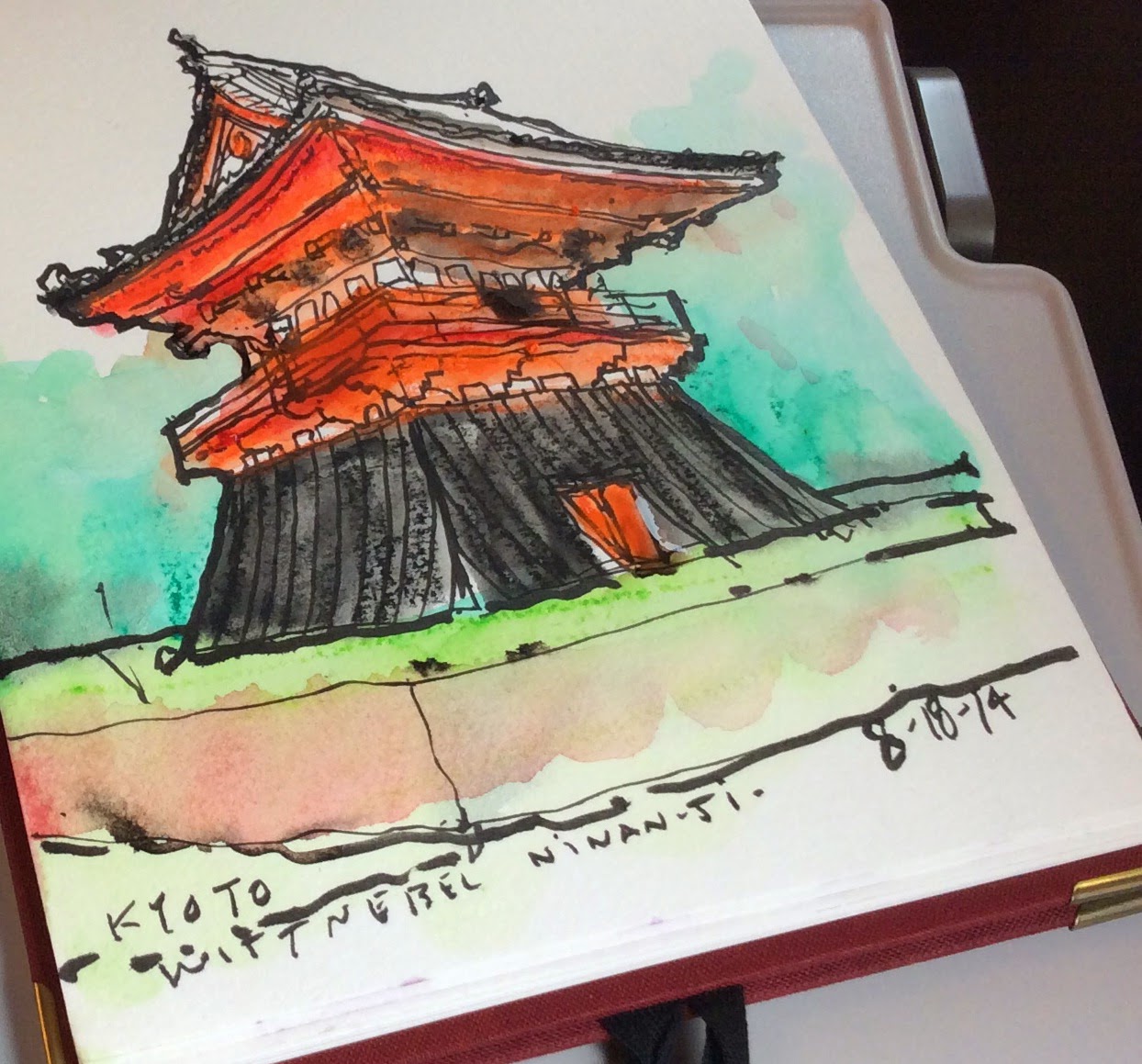
Ninna-ji, Kyoto, Shoro belfry, Japan
The temple of Ninna-ji was built at the end of the 9th century. At first it was Monseki-jiin, which also served as the residence of a member of the Imperial family who had entered the priesthood. Presently, this temple is the center of the Omuro sect of Shingon Buddhism.
To the west of the Kondo temple building there is a beautifully large and imposing vermilion tower with a bell Shoro Belfry tower, a fine example of the bell towers built in the Edo Period. It is said to have been built in the Kanei Period and it has been designated as an important cultural property. The watercolor sketch shows the vivid vermilion and black colors of the bell tower structure, a favorite combination of colors of mine.

Monday, November 11, 2013
lantern and wall at Meiji shrine
A painted view of the passage sequence at the Meiji shrine, Tokyo...

Monday, November 4, 2013
Baisoin temple
A lesser known project by Kengo Kuma, the Baiso-in temple, viewed from the 13 th floor of Tokyu stay hotel in Aoyama, Tokyo...

Tuesday, August 3, 2010


Monday, August 2, 2010
Shwedagon Pagoda, Pray and Rest

Sunday, August 1, 2010
Shwemawdaw figures, Bago, Burma

Saturday, July 31, 2010
watercolors in Burma


Subscribe to:
Posts (Atom)

-
 A selection of ink sketches done at the Ryoanji garden in Kyoto, a magical space full of mystery and a wonderful confluence of the simpl...
 -
.jpg) I had the opportunity to create a full size wall mural drawing in my office in San Ramon for Gensler and IIDA Northern Chapter event on sust...
I had the opportunity to create a full size wall mural drawing in my office in San Ramon for Gensler and IIDA Northern Chapter event on sust...